
BECOMING MANGROVE
by Nina Sandino
Performative event
Date: December 17th at 19:00
doors open at 18:30
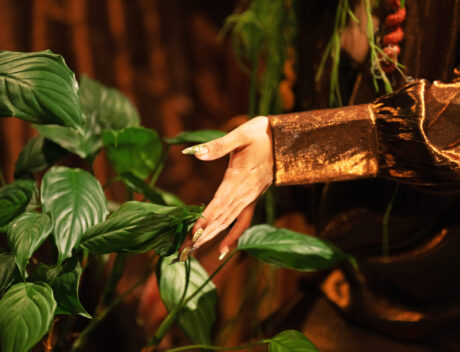
Becoming Mangrove is a performance-based research project that explores oral tradition, ecological interdependence, and caregiving through the figure and ecology of the mangrove. Rooted in Rama cosmology (an Indigenous people from the Caribbean Coast of Nicaragua), feminist and decolonial theories of care, and contemporary sound and performance practice, the work approaches shapeshifting not as metaphor but as a strategy of survival—one grounded in listening, adaptation, and responsibility toward more-than-human worlds.
The project emerges from an oral story carried through generations of women in my family: the tale of my great-great-grandfather, believed to transform into a tiger. This story—never written, only told—becomes both material and method. Rather than reconstructing an ancestral ritual, Becoming Mangrove proposes an embodied inquiry into how care, memory, and transformation persist despite migration, colonization, and the fragmentation of transmission.
BECOMING MANGROVE is both a personal return to lineage and an artistic attempt to imagine future-ancestral modes of living, sensing, and belonging.
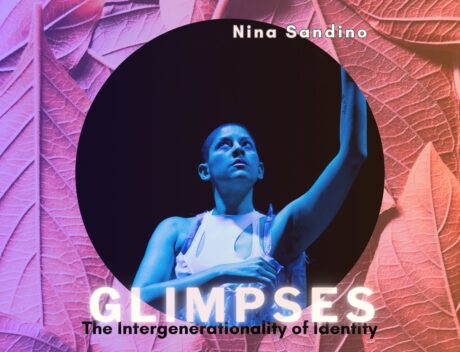
Becoming Mangrove resonates deeply with the core questions of GLIMPSES: The Intergenerationality of Identity. Through oral family stories, Indigenous cosmologies, and embodied practices of care, the work reflects on how memory survives across generations even when written archives are absent or disrupted. Sandino explores transmission not as a linear inheritance, but as a fluid, ecological, and relational process — one that persists through migration, transformation, and more-than-human connections. In doing so, the performance expands GLIMPSES’ investigation of identity into a space where ancestry, ecology, and futurity intertwine.
We kindly ask audiences to bring over-ear headphones for the best possible experience.
Credits:
Text, soundscape, costume and performance: Nina Sandino
Text and costume: Yolanda Elizabeth Rossman Tejada (my mother)
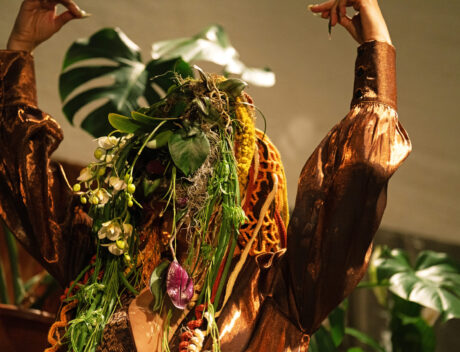
Crochet mask: Marisel Bongola (@mari_the_mob)
Clay sonorous mask: Silvia Carolina Etec Muxtay (@alfareracolibri)
Plant arrangement on mask (consultation): Master florist Antonia García Moser (@antoniamosergarcia)
Special thanks: Martin Wax
Nina Sandino (she/they)
❖ Nicaraguan Architect and Movement Artivist. Their practice focuses on Afro indigenous queer futurism and the transmission of ancestral communal knowledge. Working for holistic resistance, where rest, pleasure and joy work as radical tools for personal and collective empowerment.
Picture credits: Franzi Kreis
BIO
Interdisciplinary artist, eco-social designer and movement activist.
Born in Bilwi (‘snake in the leaf’ in the Mayangna language) on the Caribbean coast of Nicaragua, a reservoir of diverse cultures, indigenous peoples and ethnic communities.
Nina is an interdisciplinary artist who works as an eco-social designer, movement artist and activist. Her practice focuses on Afrodigenic queer futurism and communal, traditional knowledge to explore the future by looking to the past. Nina’s work is driven by the urgency of artistic expression as a political act and is interested in holistic practices in which calm, joy and pleasure act as radical tools for personal and collective empowerment. Nina understands her artistic practice as a joyful rebellion for self-preservation.
Nina has danced and collaborated with Tepenahuatl – Ballet Folklórico de Nicaragua, the artist group notfoundyet (Laia Fabre & Thomas Kasebacher), and choreographers Amanda Piña, Doris Uhlich, Ulduz Ahmadzadeh, Miguel Alejandro Castillo Le Maitre, and Ofelia Jarl Ortega. Since 2021, Nina has been working as a youth cultural worker at the Musisches Zentrum Wien and has been chair of the Austrian Professional Association for Dance Education (ÖBT) since March 2024.
[/lgc_column]